
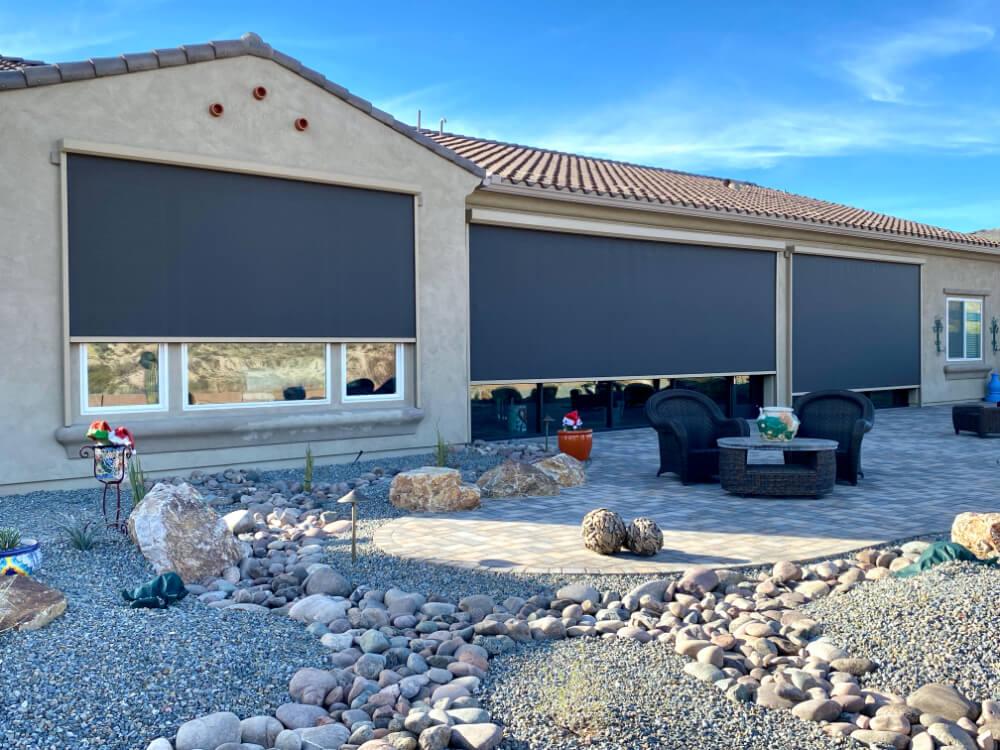
Sun glare on the TV gets worse in fall and winter because the midday sun in Las Vegas drops to roughly 30 degrees above the horizon — compared to 77 degrees in summer. That low arc sends direct sunlight deep into south- and west-facing living rooms, hitting glossy TV screens that summer sun never touched. The real fix is an exterior solar screen in a 1–3% openness fabric, deployed before sunlight crosses the glass. Interior roller shades, TV settings adjustments, and blackout curtains all fall short: they either can't stop harsh reflections already bouncing around the room, or they kill the natural daylight and view entirely. A Mermet fiberglass screen at 3% openness threads the needle: strong glare reduction, preserved outward view, and a bright, usable room.
-
47-degree seasonal sun dropWhy Las Vegas winter sun hits TV screens summer never touched
-
Fix it at the glass, not the TVInterior shades intercept light after it already scatters
-
3% openness: the starting pointStrong glare control while keeping the room usable in daylight
-
Charcoal fabric over light meshAbsorbs incoming light, reduces perceived contrast against the TV
-
Treat every south and west window in the roomOne untreated window undoes the whole fix
-
Motorized screens beat fixed panels on west windowsDeploy at 2 PM, retract at sunset, automate the schedule
Sun glare on the TV during daylight hours is a lighting problem, not a TV problem — and in Las Vegas living rooms with south or west windows, it gets measurably worse every October. The reason is seasonal sun angle: the noon sun in Las Vegas sits nearly 47 degrees lower in winter than in summer, sending direct sunlight deep into rooms that were shaded all July. The fix has to happen at the window, before the light crosses the glass and starts bouncing off reflective surfaces and the TV screen. This guide walks through why winter is worse, why common fixes fall short, and how to choose and install the right exterior solar screen to make daytime TV watchable again — without trading away natural daylight or the view.
Before you start
- Know which direction your problematic windows face — south, west, or southwest. Use your phone's compass app if you're unsure.
- Note which hours of the day the TV glare is worst: mid-morning through afternoon on south-facing windows, 2 PM through sunset on west-facing ones.
- Measure the width and height of the windows causing glare — a tape measure and notepad are enough. Exterior solar screens are custom-fitted, so accurate dimensions speed up the consultation.
- Decide what matters most for your room: glare control only, or glare control plus privacy? The answer affects fabric color and openness factor recommendations.
- Have a rough budget in mind. Exterior solar screen systems for a standard living room window run roughly $300–$900 installed, depending on size and whether you choose a fixed panel or motorized retractable option.
- Decide whether you want a fixed panel or a retractable, motorized screen — the choice affects both cost and how much control you have over passive solar warmth on cool winter days.
Understand Why Sun Glare on Your TV Gets Worse Every Fall
TV glare is a lighting problem, not a TV problem — and the seasonal shift that makes it worse in Las Vegas is sun angle, not sun intensity. At the winter solstice, the noon sun sits only about 30 degrees above the horizon at Las Vegas's latitude of roughly 36 degrees north. In summer, that same midday sun reaches 77 degrees. That 47-degree seasonal drop means sunlight that cleared your roofline and hit the ceiling in July now pours straight through south- and west-facing windows at eye level, sending direct sunlight deep into rooms it never reached in warmer months.
Many homeowners notice a TV mount position that worked fine through summer suddenly develops a constant glare problem in October. The sun isn't brighter — it's lower. A low angle sends incoming light across floors, furniture, and reflective surfaces before bouncing directly off the TV screen. Modern flat-panel TVs use glossy screens to enhance color saturation, which makes them act like a mirror for any bright light source. A 65- or 75-inch screen mounted on the wall is essentially a large mirror, and the low winter sun is the brightest thing in the room.
South-facing windows take direct rays for most of the day throughout winter. West-facing windows face a distinct glare problem in the afternoon: the sun drops toward the horizon and shoots under any overhead shading, hitting the screen from an angle that's nearly impossible to block by repositioning the TV or tilting a wall mount. Understanding this seasonal geometry is the first step, because it tells you that the solution has to happen at the window — not at the TV settings, not at the furniture layout.
Quick check
Stand at your TV at 2 PM on a clear November afternoon. If you can see a window reflection or a washed-out band across the screen, your glare source is almost certainly a south or west window. That's the window to treat first.
Rule Out the Common Fixes That Don't Stop Direct Sunlight Glare
Before spending money on a solution, clear out the approaches that look promising but fall short when direct sunlight hits the TV screen. Adjusting TV settings — brightness, backlight, picture mode — changes how the TV generates its image but cannot do anything about light bouncing off the glossy screen from outside. Cranking up the backlight to overpower the glare just adds eye strain on top of the original picture quality problem. A brighter TV setting makes the room feel like less of a contrast issue, but it doesn't reduce reflections or stop incoming light.
Blackout curtains do stop TV glare completely, but they also eliminate natural light and the view. You're sitting in a dark room to watch daytime TV, which creates a different kind of eye fatigue from the harsh contrast between the dark room and the bright screen. Repositioning fixed furniture and changing TV placement helps when the glare comes from a lamp or ceiling lights, but it can't follow the sun as it moves across the sky. TV placement changes that work at noon won't work at 3 PM on a west-facing wall — the sun moves and the wrong angle follows.
Window film applied directly to the glass is a middle-ground option. Films reduce glare by cutting visible light transmission, and the right film type can meaningfully soften incoming light — but film is permanent or semi-permanent, it applies to the glass itself rather than stopping sunlight before it enters, and it can affect the window's exterior appearance. For severe winter daytime glare on a south or west window, most window film options don't cut hard enough without also darkening the room noticeably. Interior roller shades have the same fundamental limit: DOE-cited research from the Pacific Northwest National Laboratory shows interior roller shades reduce solar heat gain by about 18%, compared to roughly 55% for exterior shades. For glare specifically, interior placement means sunlight has already crossed the glass and is already bouncing around the room before the shade intercepts it, leaving harsh reflections intact.
Why interior placement matters less than you'd think
Once sunlight passes through the glass, it scatters across walls, floors, and furniture before hitting the TV screen. Interior shades can reduce the light level, but they can't stop the harsh reflections that have already formed in the room. Exterior placement stops incoming light before it crosses the glass — that's the difference.
Choose the Right Solar Screen Fabric for Daytime Viewing in Bright Rooms
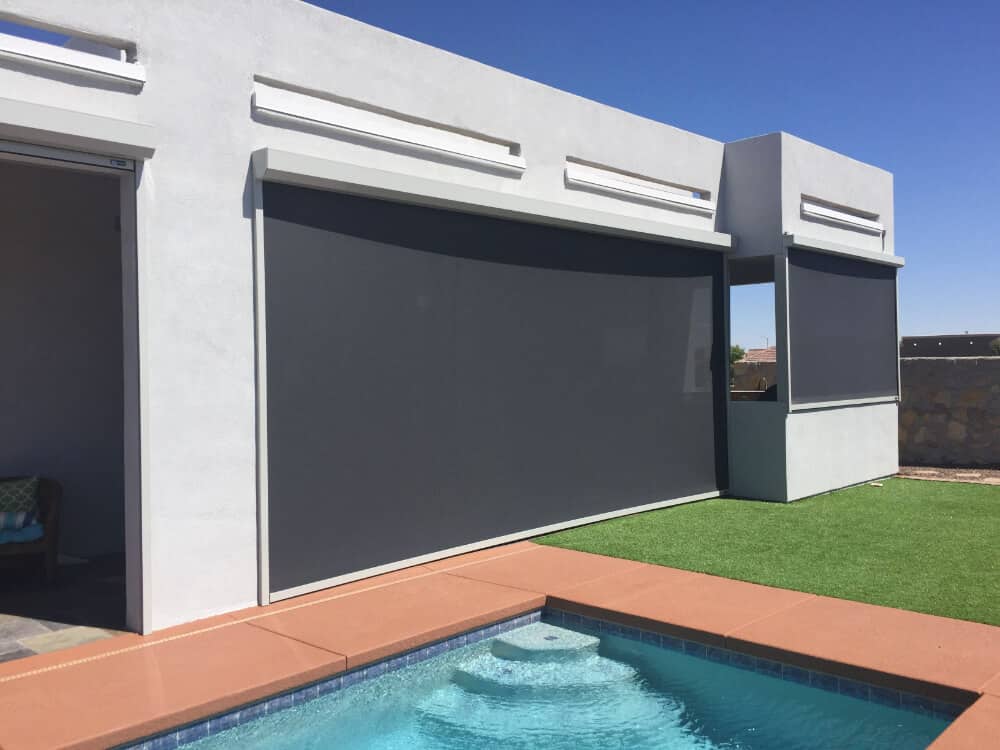
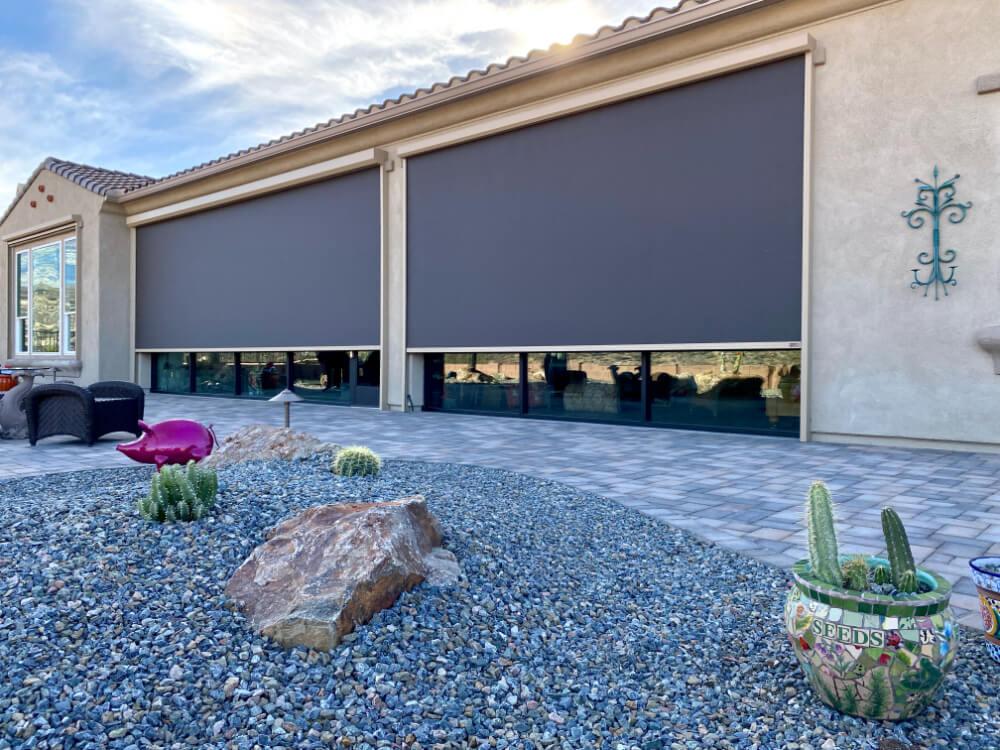
Exterior solar screens are more effective than interior shades at glare reduction from direct sunlight because they filter sunlight before it passes through the window glass. For a TV-facing living room with south or west exposure — both very bright rooms in Las Vegas winters — two spec decisions determine how well the screen actually works: openness factor and fabric color. Get these right and daytime viewing becomes comfortable. Get them wrong and you either still have glare or you've made the living space too dim to use.
Openness factor is the percentage of open space in the weave. A lower number means less light passes through. For south- and west-facing windows where TV glare is severe, a 3% openness factor is the practical starting point for most living rooms: it cuts direct sun hard enough to tame the TV screen while keeping the room bright during daylight hours. Going below 3% darkens the room noticeably; above 5% lets too much glare through for a TV-facing room. If the window is very large or the room gets intense afternoon sun from the west, dropping to 1% openness gives stronger glare control at the cost of a slightly dimmer interior. The choice depends on whether your priority is screen visibility or room brightness — most Las Vegas living rooms land at 3%.
Fabric color affects both outward view and perceived contrast against the TV screen. Darker charcoal mesh provides better visibility through the screen because it absorbs more incoming light and reduces the brightness gap between the dark TV screen and the bright window behind it. Light-colored mesh reflects more heat — which is useful for general cooling — but it can create a brighter ambient light environment that works against daytime viewing. For a TV-facing south or west window, installers consistently prefer darker fabric in the 1–3% openness range. Mermet's E Screen LOWGLARE fiberglass fabric is engineered specifically for this scenario: at 3% openness it blocks approximately 97% of UV rays, and at 1% it reaches approximately 99%. It's rated for exterior use, carries GREENGUARD Gold certification, and is the only solar screen fabric of its kind available through Desert Shade in the Las Vegas area.
Mermet E Screen LOWGLARE (1% or 3% openness, charcoal)
Included in Desert Shade's installed screen price
Engineered for glare reduction in high-sun environments; blocks 97–99% UV; exterior-rated fiberglass and vinyl construction; GREENGUARD Gold certified; 10-year no-fade guarantee
Openness factor rule of thumb
3% openness: strong glare control, room stays usable in natural daylight. 1% openness: maximum glare control, room gets noticeably dimmer. For most Las Vegas living rooms with a TV on a south or west wall, start at 3% and drop to 1% only if afternoon sun exposure is relentless.
Decide Between a Fixed Panel and a Motorized Retractable Screen
Fixed exterior solar screen panels are the simpler install and the lower-cost option. They work well on windows that receive consistent, predictable glare — a south-facing window that takes direct sunlight for most of the winter day, for example. The tradeoff is that a fixed screen is always deployed, which means you lose the option to let in passive solar warmth on a cool December afternoon when you'd welcome some extra heat. Las Vegas winters are mild enough that passive solar gain through south-facing glass can meaningfully reduce your heating load on cool days — a factor worth considering before committing to a permanent panel.
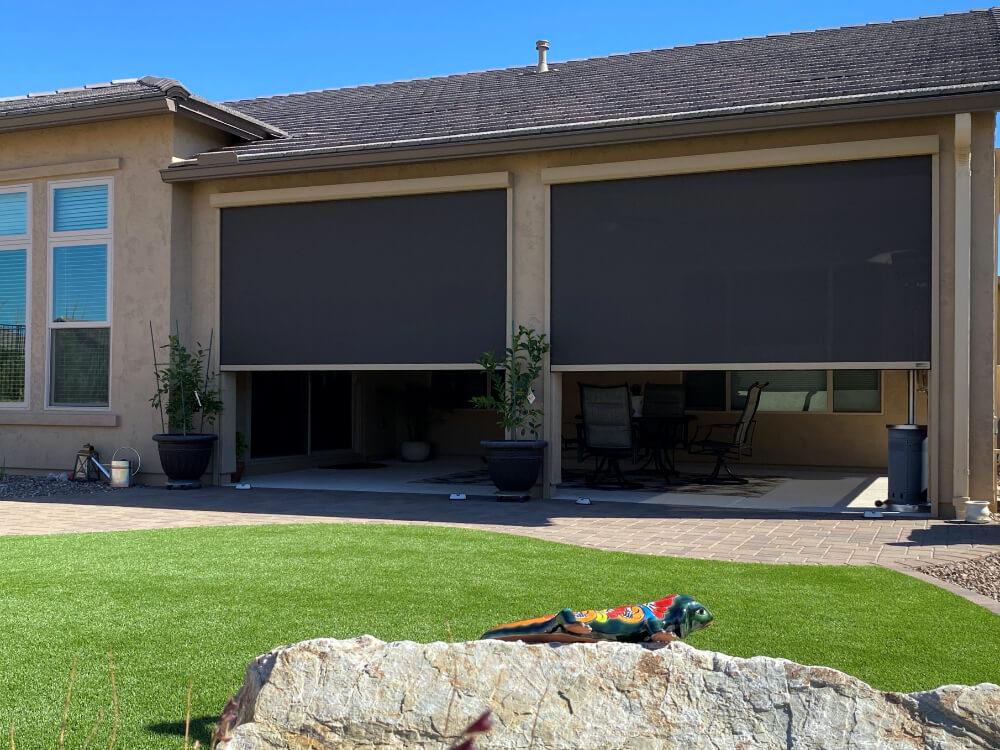
Motorized retractable exterior solar screens eliminate that tradeoff. You can lower the screen during peak glare hours — typically 11 AM to 3 PM on south-facing windows, 2 PM through sunset on west-facing ones — and retract it on overcast days or evenings when you want the full view or the warmth. Desert Shade installs motorized retractable screens with smart-home integration through the Bond app, Alexa, and Google Home, so you can automate a schedule that matches the sun's pattern rather than adjusting manually every day. Solar-powered motor options are available, eliminating the need to run electrical wiring to the installation point.
For most Las Vegas homeowners dealing with winter TV glare on a west-facing window, the motorized retractable screen is the more practical long-term choice. The sun angle changes daily and the problem is worst in a predictable window of afternoon hours — a retractable system gives you full control rather than permanent shade. If your south-facing window is the problem and glare runs for most of the daylight hours in winter, a fixed screen at 3% openness may be the simpler, equally effective real solution.
Solar-powered motors
Desert Shade's motorized retractable screens can run on solar power, which eliminates the need to run electrical wiring to the window. That makes installation cleaner and less invasive, especially on finished exterior walls — no conduit, no wall penetrations.
Measure Your Windows Accurately Before the Consultation
Exterior solar screens are custom-fitted to each window opening — there are no standard sizes. Before your consultation with Desert Shade, taking accurate measurements saves time and helps the conversation move faster. Measure the width and height of each window you want to treat, from the outer edges of the frame, not the glass itself. Note whether there's a wall, trim, or soffit obstruction above the window that would limit how a retractable screen mounts. Big windows and very large windows may need additional mounting hardware for lateral stability, which the professional installer will identify on-site.
Also note the glare source hours for each window. South-facing windows typically cause TV glare from mid-morning through mid-afternoon in winter. West-facing windows hit hardest from about 2 PM until sunset. Write down when the TV screen becomes unwatchable — that tells the installer which windows to prioritize and confirms the sun angle geometry. Poor installation placement — mounting too close to the frame, leaving gaps at the sides — allows low-angle winter light to sneak around the screen's edges and still hit the TV, so the mounting position matters as much as the fabric spec.
If you have multiple south or west windows in the same room, treat them all. Fixing one large window while leaving an adjacent one uncovered won't eliminate the glare — the low winter sun will simply find the untreated glass and bounce off the same reflective surfaces in the room. Desert Shade measures on-site and handles all custom cutting and fitting, so your pre-consultation measurements are a starting point, not the final spec. The goal is clear instructions for the installer from the first visit, so fabrication can begin immediately.
Schedule Installation and Set Up Daytime Viewing for the Rest of Winter
Once the fabric spec, openness factor, and motor configuration are confirmed, Desert Shade handles fabrication, delivery, and installation. As a manufacturer-direct, certified dealer with no middleman markup in the pricing, motors and electronics carry a lifetime warranty with some limitations. The 10-year no-fade guarantee on the Mermet fiberglass fabric means the screen installed this winter will perform identically years from now — unlike bargain-grade mesh that sags and loses screen visibility under sustained sun exposure in the desert.
After installation, set a schedule if you've chosen a motorized screen. For a west-facing living room TV, lowering the screen at 1:30 PM and retracting it at sunset covers the worst of the winter glare window without keeping the screen deployed all day. If you've integrated the screen with Alexa or Google Home via the Bond Bridge, you can build an automation that runs on a timer without touching the app — the sun moves on a predictable arc and your screen schedule can match it exactly. That's the practical advantage of a motorized exterior system over any interior shade or blackout curtains: you're managing the light source from outside the glass, on a schedule that matches how the sun actually moves across your specific wall.
The result is a living space that stays bright with natural daylight and an outward view, while the TV screen is watchable without eye strain from constant glare during daylight hours. For anyone spending several hours a day in that room, peer-reviewed research published in NIH/PMC confirms that eliminating constant glare from surrounding light sources significantly reduces eye fatigue and discomfort. That's the difference between an exterior solar screen and a blackout curtain: you get light control without dark rooms, and you get it on demand. The better viewing experience is simply a byproduct of fixing the actual problem — the light source.
Eye strain and health context
Peer-reviewed research published in NIH/PMC confirms that minimizing glare by adjusting ambient light can significantly reduce eye strain, headaches, and eye fatigue. For a room where someone watches TV for several hours a day, eliminating constant glare from low winter sun is a meaningful quality-of-life improvement, not just a picture quality fix.
Don't Let Daytime Glare Sideline Your Living Room All Winter
The low winter sun in Las Vegas isn't going anywhere until March. If your TV screen is washed out during daylight hours, the problem will get worse as the sun continues its low arc through December and January — not better. Interior blinds and TV settings won't stop it. Blackout curtains will, but at the cost of natural daylight and the view. An exterior solar screen in Mermet fiberglass fabric at 3% openness threads the needle: it filters direct sunlight before it hits the glass, keeps the room bright, preserves the outward view, and makes daytime TV watchable again. Desert Shade is the only dealer in the Las Vegas area offering Mermet fiberglass fabric, and we install manufacturer-direct with no middleman pricing. Contact Desert Shade today to schedule your free consultation — we'll measure, spec, and install the right screen for your windows before the winter glare season peaks.
Ready to watch TV during the day without squinting at a washed-out screen? Desert Shade offers exterior solar screens built specifically for Las Vegas's desert sun and low winter sun angles. Our team will help you choose the right Mermet fiberglass fabric, openness factor, and motorization option for your south- or west-facing living room windows. Contact Desert Shade today to schedule your free consultation and get daytime viewing back.
Frequently Asked Questions
Ready to get started? Contact Desert Shade today.